
RGU holds ‘Popularisation of Life Science’ event for school children
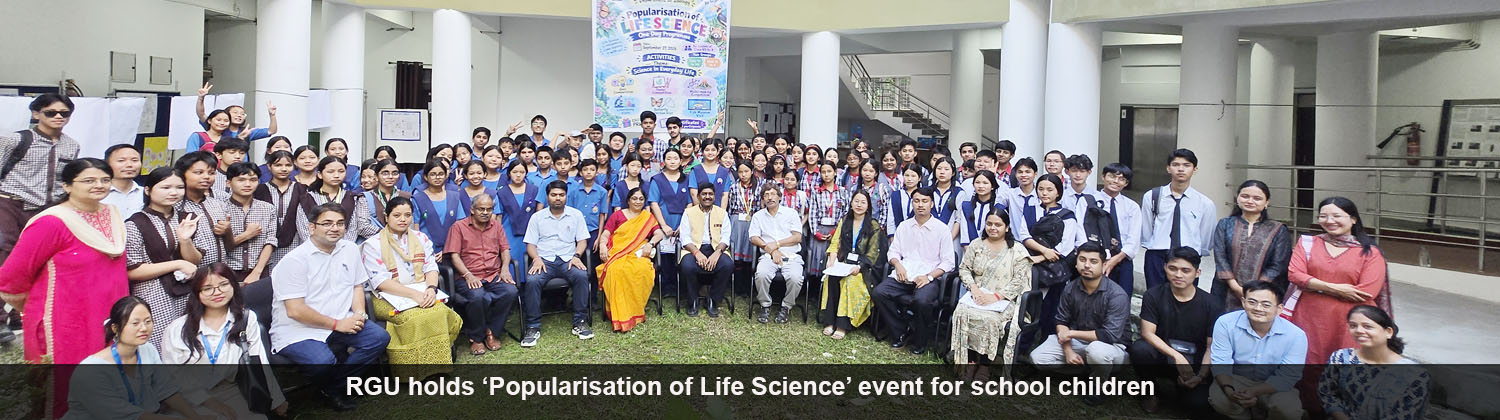
RONO HILLS, Sep 28: The Department of Zoology, Rajiv Gandhi University (RGU), hosted a one-day programme ‘Popularisation of Life Science’ on Sunday.
A total of 85 students of Classes VII to X showcased posters and models and took part in a quiz competition. They came from four schools: Vivekananda Kendra Vidyalaya, Nirjuli; Kendriya Vidyalaya, NERIST Campus; Senior Sec School, RGU Campus; and Alphabet Public School, Amba, Doimukh.
Designed as a social outreach and sensitisation initiative, the programme sought to give school students an early, first-hand experience of a university science department, and to show them what higher education and research in the life sciences look like in practice.
RGU Vice Chancellor Prof Shivraj, who attended the programme, commended the Department of Zoology for its vision and efforts. He emphasized that the university should conduct more social outreach programmes of this kind to give students wider exposure, and added that future editions should include more schools.
Prof D N Das, HoD Zoology and Chairman of the programme, spoke on the beauty of life science and zoology. He described zoology as a subject that helps us understand the living world, from the smallest insect to the largest animal.
Dr Arnab Ghosh, Organising Secretary and Convenor, said that social outreach, and sensitizing young school students to higher education and research at an early age, are key components of the National Education Policy (NEP) 2020. He said that engagements like this will plant the seed of scientific curiosity in young minds, and that the Dept of Zoology would be happy to carry the initiative forward and support the students in their scientific endeavours.
Earlier, the day began with poster-making and model-making competitions on the theme ‘Science in Everyday Life’, held in two groups: Classes VII–VIII and IX–X. The students displayed 52 posters and 15 models, and explained their ideas to the judges and visitors.
The entries reflected creativity, careful observation and a clear grasp of scientific concepts, linking classroom biology with health, food, the environment and the living world around them.
A quiz competition followed, testing the participants knowledge of life science and general science, and drew lively participation and keen interest from the audience. (Source: EoA)