
Cabinet lauds Modi’s 25 years of continuous service highlights Centre’s development initiatives & their impact on Arunachal
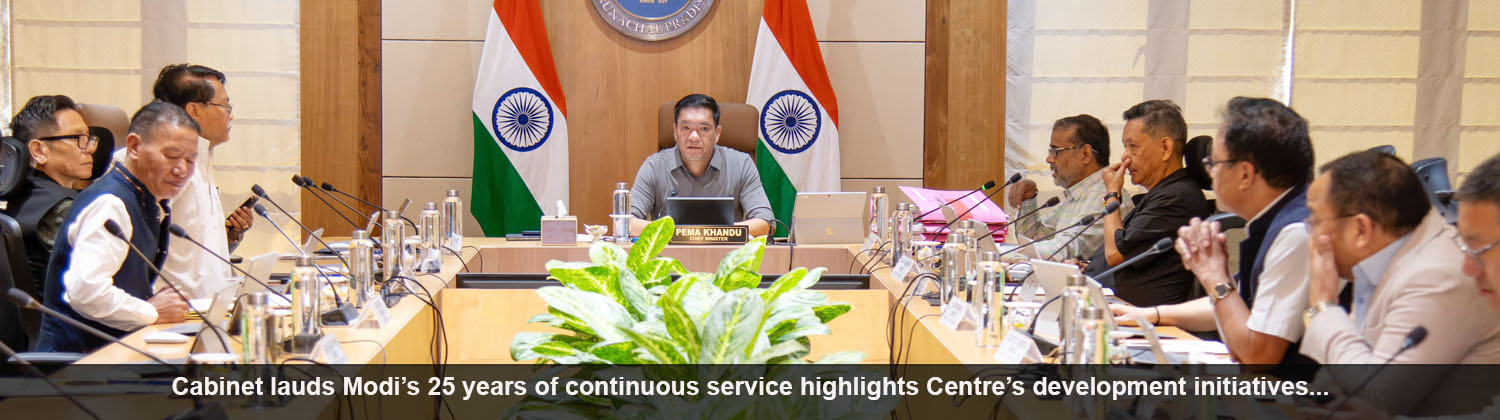
ITANAGAR, Oct 11: The Arunachal Pradesh Cabinet, led by Chief Minister Pema Khandu, on Sunday adopted a resolution congratulating Prime Minister Narendra Modi on completing 25 years of continuous service as head of government, highlighting his leadership and the impact of various central schemes on the state.
Modi began his tenure as Gujarat Chief Minister on October 7, 2001, and became Prime Minister on May 26, 2014. He is currently serving his third consecutive term as Prime Minister, which began on June 9, 2024.
The Cabinet described his public life as guided by the principle of Seva Hi Samarpan and the governance mantra of “Sabka Saath, Sabka Vikas, Sabka Vishwas and Sabka Prayas”. It credited his leadership with advancing welfare delivery, economic growth, national security, infrastructure development, technological progress and the preservation of India's cultural heritage.
The Cabinet cited major policy initiatives, including the abrogation of Article 370, the replacement of colonial-era criminal laws with the Bharatiya Nyaya Sanhita, the introduction of the Goods and Services Tax (GST), and the subsequent GST 2.0 reforms.
The Cabinet also expressed gratitude to Modi for launching the next-generation GST 2.0 reforms and GST Bachat Utsav during his visit to Itanagar on September 22, 2025.
Highlighting the impact of central welfare schemes in Arunachal Pradesh, the resolution stated that more than 8.57 lakh beneficiaries were covered under the Pradhan Mantri Garib Kalyan Anna Yojana, while around 55,000 families received pucca houses registered in women's names.
The state also achieved 100 per cent saturation under the Jal Jeevan Mission, with 2.28 lakh households receiving functional tap water connections, becoming the first state in the Northeast to achieve the milestone. More than 2.26 lakh families are covered under Ayushman Bharat Pradhan Mantri Jan Arogya Yojana (AB PM-JAY) and the Chief Minister Arogya Arunachal Yojana (CMAAY), providing cashless treatment coverage of up to Rs 5 lakh per family annually.
The Cabinet further highlighted livelihood and youth initiatives, stating that more than 1.14 lakh farmers in the state were enrolled under PM-KISAN, receiving over Rs 150 crore through direct benefit transfers. Nearly one lakh women have been mobilised into 15,999 self-help groups, while more than 16,000 women have become Lakhpati Didis.
In education, 50 government schools have been upgraded into Golden Jubilee Model Schools, while 58 Khelo India Centres have been established across the districts. The state has also supported 156 startups with seed funding exceeding Rs 5.59 crore, of which 45.5 per cent are women-led, the resolution stated.
On infrastructure, the Cabinet cited the Sela and Nechiphu tunnels, Donyi Polo Airport and the upgradation of Tezu Airport as major developments improving connectivity, strategic mobility and tourism.
Under the Vibrant Villages Programme, 455 villages across 11 districts were selected in Phase I, while 1,022 km of roads worth Rs 2,205 crore were approved to connect 126 border villages. Another 122 villages along the Myanmar and Bhutan borders were included in Phase II.
The resolution also highlighted Arunachal Pradesh’s hydropower potential, noting that four units of the 2,000-MW Subansiri Lower Hydroelectric Project had been commissioned, while investments of more than Rs 52,000 crore had been approved for five additional hydropower projects with a combined capacity of nearly 4,000 MW.
The Cabinet also acknowledged central support for preserving the state's indigenous, tribal and Buddhist heritage. It noted that 20 indigenous products had received Geographical Indications (GI) tags and that Arunachal Pradesh was among six Northeastern states covered under the Union Budget 2026–27 scheme to develop Buddhist circuits. Additionally, Rs 4,900 crore had been allocated to the state under the Pride of Hills component of the Special Assistance to States for Capital Investment, the resolution stated.
The Cabinet reaffirmed its commitment to building on these initiatives towards the national vision of Viksit Bharat by 2047, extending congratulations to Modi and pledging to work towards a prosperous, secure, self-reliant and developed India. (Source: EoA)